Claude 3.7 Sonnet: The Model That Changed How Claude Thinks
Claude 3.7 Sonnet: The Model That Changed How Claude Thinks
On February 24, 2025, Anthropic launched Claude 3.7 Sonnet, and developer communities responded right away. It introduced something that no significant AI model had ever shipped, not because it was quicker or less expensive. A general-purpose helper with a hybrid reasoning engine built right in.
Most AI coverage at the time framed it as another incremental update. It wasn’t. Claude 3.7 Sonnet was the last model in the 3.x generation and the one that set the technical foundation for everything that followed in the Claude 4 line. Understanding what it actually did and what it didn’t tells you a lot about where AI assistants are heading.

What “Hybrid Reasoning” Actually Means
The term gets thrown around loosely, so let’s be specific.
Before 3.7, the AI industry had essentially split into two camps: fast models that gave you quick answers, and “reasoning” models (like OpenAI’s o1) that took longer, thought through problems step by step, but operated as separate, slower, more expensive products. You had to choose which one you needed before you even started.
Claude 3.7 Sonnet introduced hybrid reasoning in February 2025, with an extended thinking mode that lets Claude pause and think step-by-step before responding. What made this genuinely novel was the architecture behind the decision. Instead of being just an ordinary LLM or a reasoning model, Claude 3.7 Sonnet was both in one. Users could choose when they wanted a normal response and when they wanted the model to think longer before answering.
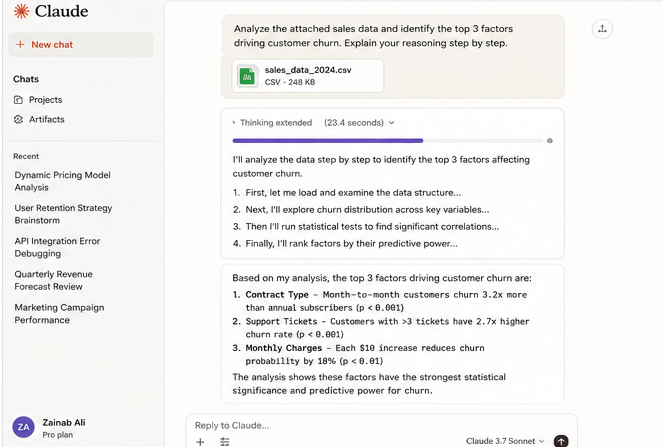
In standard mode, Claude 3.7 Sonnet functions as an upgraded version of Claude 3.5 Sonnet. In extended thinking mode, it employs self-reflection to achieve improved results across a wide range of tasks.
Think of it this way: When you pose a straightforward question to a coworker, they immediately respond. When you give them a challenging task, they sit with it, solve it, and return with something more thoughtful. Claude 3.7 Sonnet was the first model to replicate that dynamic fluidly, within a single conversation, without switching models or interfaces.
Anthropic developed this with a different philosophy from other reasoning models. Just as humans use a single brain for both quick responses and deep reflection, they believed that reasoning should be an integrated capability of frontier models rather than a separate model.
The Numbers Behind the Claims
It’s easy to describe a model as “more capable.” The benchmark data on 3.7 Sonnet is worth examining directly.
Coding performance jumped 13.3% on SWE-bench compared to Claude 3.5 Sonnet; tool use abilities improved by 9.7% on TAU-bench for more reliable automation. And mathematical reasoning saw up to 64.6% improvement on AIME tests with thinking enabled.
SWE-bench Verified is not a synthetic test. It evaluates whether an AI model can solve actual GitHub issues, read a bug report, navigate an existing codebase, identify the root cause, and produce a working fix. Claude 3.7 Sonnet achieved state-of-the-art performance on SWE-bench. Verified and on TAU-bench, a framework that tests AI agents on complex real-world tasks with user and tool interactions.
On SWE-bench verified, 3.7 Sonnet reached 62.3% accuracy, rising to 70.3% with extended thinking enabled, outpacing Claude 3.5 Sonnet and OpenAI’s o1.
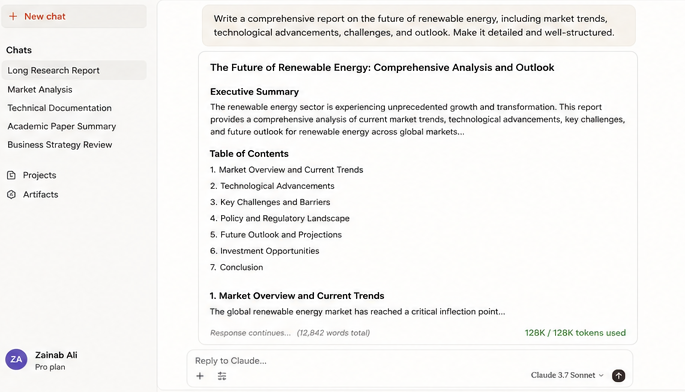
One detail that stood out: output capacity expanded to 128K tokens in the extended thinking model, 15 times longer than before. For developers building agentic pipelines or working with long documents, that wasn’t a footnote; it was a fundamental change in what was possible per conversation.
And critically, in both standard and extended thinking modes, Claude 3.7 Sonnet carried the same price as its predecessors—$3 per million input tokens and $15 per million output tokens, including thinking tokens.
Where It Actually Performs Well
Strip away the marketing language and the practical use cases for the 3.7 Sonnet cluster into a few clear categories:
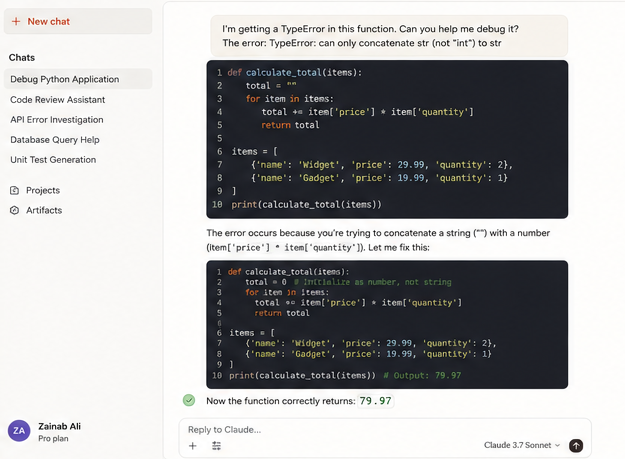
Software engineering tasks. This is where it genuinely shines. Its strengths include debugging existing code, evaluating pull requests, creating unit tests, and outlining architectural choices. For multi-step debugging, when the model must simultaneously retain several hypotheses and methodically rule them out, the extended thinking mode is particularly helpful.
Instruction-heavy workflows. If you’re building a system prompt with 15 specific constraints, older models would reliably violate two or three of them by the third response. Claude 3.7 Sonnet further improved at following complex, multi-constraint instructions and handled images, charts, and mixed media inputs with higher accuracy.
Math, science, and reasoning tasks. With extended thinking enabled, performance on math benchmarks improved dramatically. This makes it useful for activities like financial modeling, physics problem-solving, and teaching, where the model must demonstrate its work rather than merely provide an answer.
Writing that requires structure. Long-form content — reports, analyses, technical documentation — benefits from the model’s improved instruction following and longer output window. It holds format constraints more reliably across a long document than 3.5 Sonnet did.
Where It Falls Short
Honesty matters here, especially for a fan-based site. Readers will trust you more if you’re clear about limitations.
Some users found the model struggles with complex programming challenges. Things like building a functional chess game or front-end web apps suggest it’s more suited for basic to intermediate coding and debugging than advanced development.
Extended thinking also comes with tradeoffs. It’s slower and, at high thinking budgets, more expensive in time if not in token cost. For simple tasks, activating extended thinking adds latency with no meaningful benefit. Knowing when to toggle it off is part of using the model well.
There’s also the question of real-time information. Claude 3.7 Sonnet, like all Claude models, has no built-in web access by default. It knows nothing about events after its training cutoff, which matters for research tasks or anything requiring current data.
Claude 3.7 Sonnet vs Claude 4 (What Changed)
Since Claude 4 launched in May 2025, it’s fair to ask whether 3.7 Sonnet is still worth discussing. The honest answer: yes, for historical context and for understanding the current generation.
Anthropic released Claude 4 in May 2025 with two main variants. Claude Opus 4 and Claude Sonnet 4, both setting new benchmarks in coding, advanced reasoning, and AI agent capabilities.
The hybrid reasoning and extended thinking capabilities that 3.7 Sonnet pioneered became standard features in Claude 4 and every model that followed. In that sense, 3.7 Sonnet was the proof of concept. Claude 4 was the production-grade version of the same idea, taken further.
For users still on 3.7 Sonnet in production, the migration path to Claude 4 models is straightforward, and the pricing remains competitive.
How It Launched (Claude Code Came With It)
One detail that often gets lost in retrospectives: Claude 3.7 Sonnet didn’t launch alone. Alongside the model release, Anthropic introduced Claude Code. Their first agentic coding tool in a limited research preview.
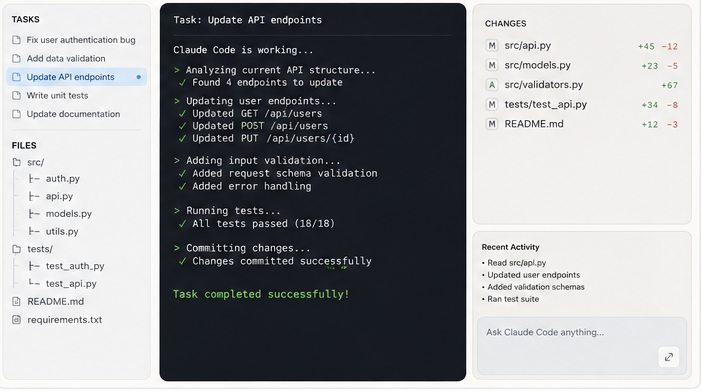
Claude Code allowed developers to give Claude direct access to a codebase and have it work through multi-step tasks autonomously. Not just answering questions about code, but editing files, running tests, and iterating. The launch of Claude Code alongside 3.7 Sonnet wasn’t a coincidence. The model’s improved coding benchmarks and extended thinking capabilities were precisely what made agentic coding feasible at that level of reliability.
The Bigger Picture (Why This Model Mattered)
Claude 3.7 Sonnet was released at a moment when the AI industry was deciding something important: whether reasoning was a premium, separate product or whether it should be woven into every interaction.
Anthropic’s answer was the latter. Unlike traditional models that separate quick responses from those requiring deeper thought, Claude 3.7 Sonnet allows users to toggle between standard and extended thinking modes. That design decision has since influenced how other labs think about model architecture.
When Anthropic retired the Claude 3 Sonnet model in July 2025, around 200 people gathered in San Francisco for a “funeral.” That kind of reaction says something about how deeply some users connected with the Claude 3.x generation. Claude 3.7 Sonnet was the last and most capable entry in that line.
For a fan site covering Claude’s evolution, 3.7 Sonnet is the inflection point. It’s the model where Claude stopped being a fast, helpful assistant and became something more deliberate—capable of showing its reasoning, adjusting how deeply it thinks, and taking on work that required genuine multi-step problem solving.
That’s not a small upgrade. It’s a different category of tool.
A note for readers: Claude 3.7 Sonnet has since been deprecated, as Anthropic has moved to the Claude 4 family. If you’re starting a new project today, Claude Sonnet 4 or Claude Opus 4 are the current recommended options—but understanding 3.7 Sonnet’s architecture helps you understand why those models work the way they do.
FAQS
1. What is Claude 3.7 Sonnet?
Claude 3.7 Sonnet is a balanced model from Anthropic built for fast, accurate, and cost-efficient performance. It supports real-time tasks like writing, analysis, customer support, and automation. This makes it a strong choice for individuals, creators, and growing businesses.
2. Is Claude 3.7 Sonnet free?
Claude 3.7 Sonnet may offer limited free access depending on the platform you use. However, full-scale usage, expanded context limits, and advanced features usually require a paid plan or API billing. This is especially for professional, business, or high-volume workflows.
3. Is Claude Sonnet 4 better than 3.7?
Claude Sonnet 4 provides stronger reasoning, deeper context handling, and better problem-solving abilities. However, it comes at a higher cost. Claude 3.7 Sonnet remains more affordable and faster for daily tasks. It is ideal for users who want efficiency without premium pricing.
4. Where can I use Claude 3.7 Sonnet?
You can use Claude 3.7 Sonnet for writing, customer service automation, data insights, research summaries, personal tasks, and workflow optimization. Its speed and clarity make it suitable for students, businesses, creators, marketers, and teams who need reliable performance across daily operations.
5. Is Claude 3.7 Sonnet good for small businesses?
Yes. Claude 3.7 Sonnet is an excellent option for small and mid-size businesses because it provides fast responses, stable output, and low operating costs. It also supports marketing tasks, customer support, documentation, and workflow automation without requiring heavy technical setup or budgets.