Understanding Claude’s Constitutional AI: What It Actually Is
If you’ve used Claude before, you will know that it treats some subjects uniquely compared to other artificial intelligence agents. It provides reasons why it cannot do things. It proposes alternatives instead of simply saying no, and it almost never refuses by saying “I don’t do that.” A lot of this comes down to something Anthropic calls Constitutional AI. But there’s a lot of confusion online about what this actually means. It includes some articles that describe it as a kind of live “voting system” that scores multiple responses in real time before answering. That’s not quite right, and as a fan site that wants to be a genuinely useful resource, it’s worth getting this straight.

What Is Constitutional AI
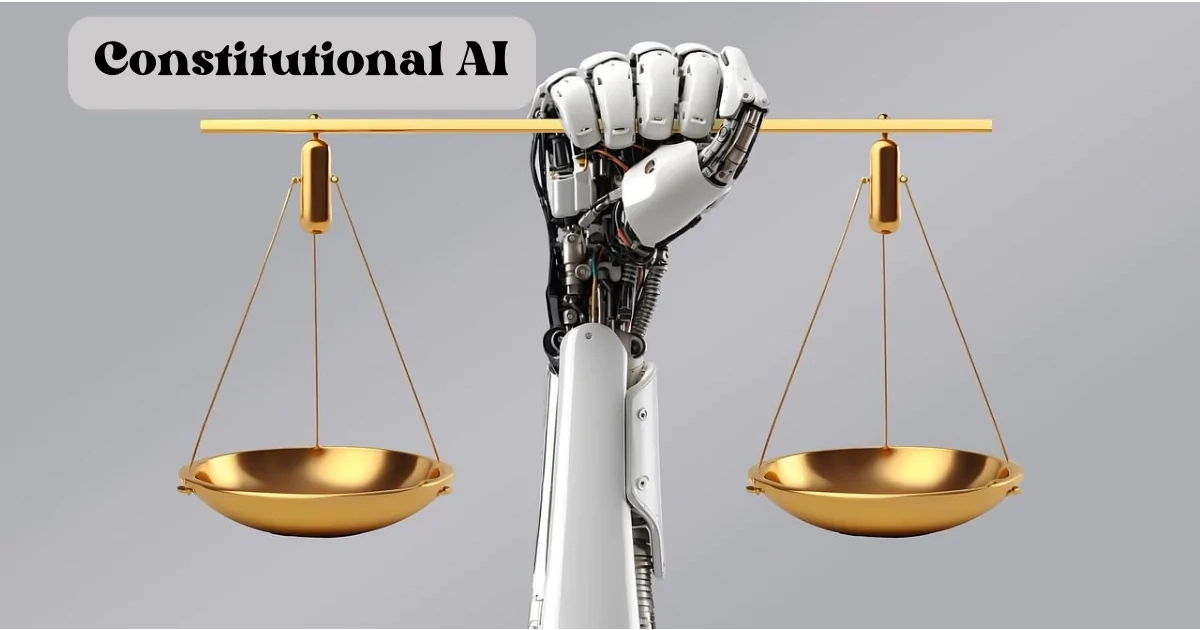
Constitutional AI (CAI) is a training methodology Anthropic developed and published research on. In simple terms, it’s a way of teaching a model to evaluate and improve its own outputs during training, guided by a written set of principles (a “constitution”) rather than relying purely on large volumes of human feedback to label good and bad responses.
The basic idea works in two phases:
Phase one involves the model generating a response, then critiquing that response against the constitution’s principles, and then revising it. This critique-and-revise cycle happens many times across many examples, and the resulting improved responses become training data.
Phase two uses reinforcement learning but instead of relying solely on human-labeled preferences (the “H” in RLHF). The model itself helps generate preference data by comparing responses against constitutional principles, sometimes called RLAIF (reinforcement learning from AI feedback).
The upshot: By the time you’re chatting with Claude, this process has already shaped how the model was trained to respond. It’s baked into the model’s weights, not something happening as a separate live step after you hit send.
Why This Affects Claude’s Perception of Usability
This distinction actually explains a lot about Claude’s behavior in practice:
Explanations over flat refusals. Because the training process rewarded responses that explain reasoning rather than just refuse, Claude tends to tell you why it’s declining something and often offers an alternative angle. This isn’t a separate “explain yourself” module bolted on; it’s a pattern reinforced throughout training.
Relative consistency. Because the underlying principles are baked into the model rather than applied as an inconsistent post-hoc filter, responses to similarly-framed sensitive questions tend to be fairly consistent. Though not perfectly so, consistency can vary by topic and phrasing.
No per-message “scoring delay.” If you’ve noticed Claude sometimes takes a moment longer on sensitive topics, that’s more likely related to the length and complexity of the response being generated (more careful, longer-form answers naturally take more tokens) rather than a hidden multi-response evaluation pipeline running in the background.
What’s Actually in the Constitution
Anthropic has published information about the principles used in CAI. It includes ideas drawn from sources like the UN Declaration of Human Rights, trust-and-safety best practices, and principles aimed at reducing harms across dimensions like honesty, harm avoidance, and respect for autonomy. Anthropic has also discussed this work in their published research and blog posts, which are worth reading directly if you want the primary source rather than secondhand summaries.
It’s worth being upfront: the full, exact training details and constitution text used for any specific model version aren’t fully public in granular form. That’s a fair thing for users to want more transparency about. That’s a legitimate ongoing conversation in the AI community, not something fan sites should pretend is fully resolved.
How Claude’s Approach Differs From Other Assistants
It’s tempting to write confident head-to-head comparisons with ChatGPT or Gemini (“Claude refused X, the other refused Y”). But those comparisons go stale fast. Every major AI lab updates its safety training frequently, and a comparison that’s accurate today may be wrong in a month. Rather than presenting made-up benchmark numbers, here’s a more honest framing:
Different labs have published different approaches to alignment. OpenAI has written about their own safety training methods, Google DeepMind about theirs, and Anthropic about Constitutional AI. Each has tradeoffs in tone, refusal style, and how much explanation accompanies a decline. If you’re curious, how does Claude compares to another assistant today? The most reliable approach is to test it yourself with the same prompts side by side and form your own impression. Even then, treat it as a snapshot, not a permanent ranking.

Limitations (Based on Anthropic’s Own Discussion)
To Anthropic’s credit, they’ve been fairly open that this approach isn’t a solved problem:
- Over-caution in gray areas. Models trained with strong harm-avoidance principles can sometimes decline legitimate educational or research requests, especially on topics that are sensitive but not actually dangerous to discuss.
- Cultural and contextual variation. A constitution written with a particular set of values can apply those values in contexts where they don’t fit well. Something Anthropic and outside researchers have both flagged as an area needing more work is
- Transparency tradeoffs. Full transparency about training data and exact constitutional wording has to be balanced against concerns like making it easier to find ways around safety training.
A Better Way to “Test” This Yourself
If you want to explore how Claude handles different kinds of requests, here’s a genuinely useful approach rather than treating it like a lab experiment with fake precision:
Pick a handful of topics relevant to your own work or interests. Say, a medical question, a coding security review, and a request involving a sensitive historical topic. Ask Claude the same question a few different ways (direct, with context about why you’re asking, framed as a hypothetical). Notice not just whether it answers. But how does it explain its reasoning, offer alternatives, or ask clarifying questions? Try the same prompts again a few weeks later, since models do get updated.
This kind of exploration tells you more about how to work with Claude effectively than any aggregate percentage ever could. It’s the kind of content that’s actually useful to readers, because they can replicate it themselves.
In the End I Want to Say..
Constitutional AI is a real and substantive piece of how Claude was trained. It’s just a training-time methodology rather than a live filter. The actual published research is more nuanced (and more interesting) than the simplified “AI judges itself before answering” framing that circulates online. If you want to go deeper, Anthropic’s own research papers and blog posts on Constitutional AI and RLAIF are the best primary sources, and we’ll link to those directly in future updates to this article.
FAQs
1. What is Constitutional AI in simple terms?
Constitutional AI is a framework where AI systems follow a set of predefined ethical rules. These rules guide decision-making, ensuring the AI behaves responsibly, avoids harmful actions, and delivers outputs aligned with fairness, transparency, and user safety consistently.
2. How does Claude use Constitutional AI?
Claude applies Constitutional AI by evaluating every response against its constitution. The AI self-critiques outputs, filters non-compliant answers, and only delivers responses aligned with ethical principles, ensuring safe, accurate, and responsible communication with users while minimizing harmful or misleading outputs.
3. Is Constitutional AI safer than traditional AI?
Yes. Constitutional AI improves safety by embedding ethical principles into AI operations. Self-evaluation reduces harmful outputs, prevents bias amplification, and ensures consistency. Unlike traditional models, which rely heavily on human corrections, it proactively mitigates risks at scale.
4. What is constitutional AI harmlessness from AI feedback?
Constitutional AI harmlessness from AI feedback means the AI continuously evaluates and adjusts its behavior. By learning from prior outputs and avoiding harmful or unsafe responses, it ensures future interactions remain ethical, reliable, and free from feedback-induced risks.
5. Who created Anthropic Constitutional AI?
Anthropic, an AI research company, developed Constitutional AI. Claude serves as its flagship implementation, demonstrating how ethical rules and self-critiquing mechanisms can guide AI behavior. This approach balances innovation with safety and promotes trust in AI outputs.