Claude for Teachers: What the Free Program Really Offers in 2026
Claude for Teachers: What the Free Program Really Offers in 2026
ClaudeAIWeb was created since accurate information on Claude was hard to come by. The same is true for teachers. Pages just reiterate launch dates and go no further. Even some of them have outdated dates. One competitor’s webpage, for instance, claims that the free program expires in 2027.
This date is no longer valid. Hence, I updated this guide according to Anthropic’s official announcement and latest developments. Here, a truthful look at Claude for Teachers is provided. You will learn its features, requirements, and shortcomings.
If you are not familiar with Claude, read our AI Guide part first.
What Is Claude for Teachers?
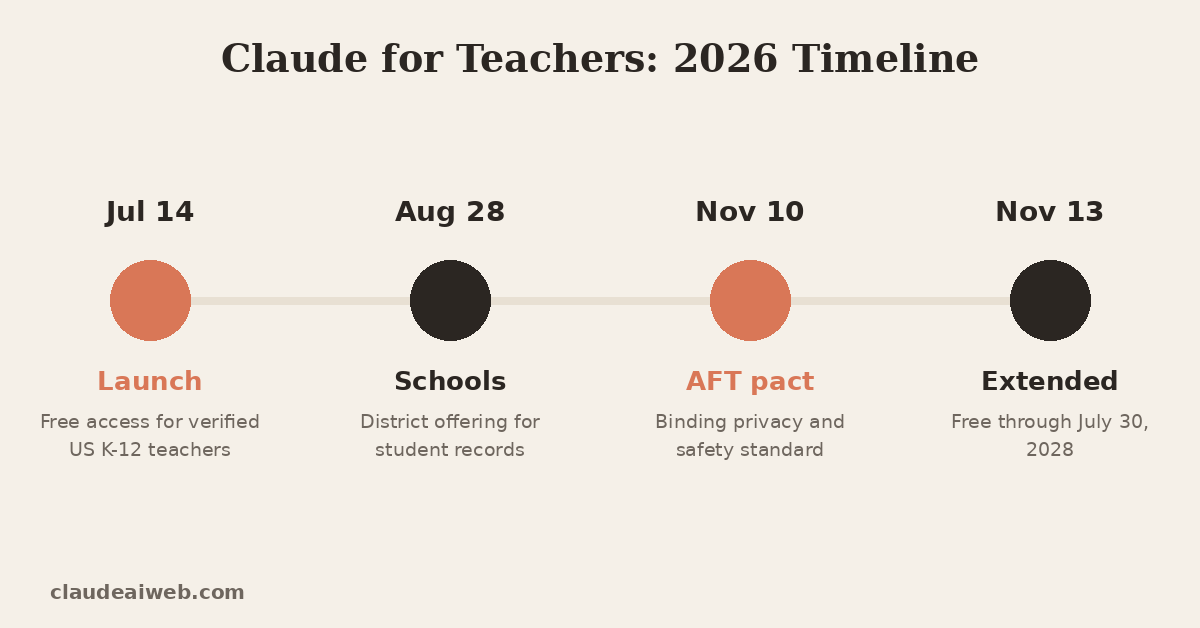
The Claude for Teachers Program is a complimentary initiative designed exclusively for teachers. The Anthropic team released it on July 14, 2026, to verified K-12 teachers in the US. The program provides access to premium Claude functionalities, the library of teaching skills, and the curriculum.
There are two key considerations here. First, the program addresses adult users exclusively. Anthropic designed the program for educators to comply with the 18 years or older policy for Claude. Second, the program addresses individual users exclusively. Anthropic designed the original version of the program for individual educators and later introduced the school and district programs on August 28, 2026.
Thus, your choice will depend on your status. If you are a teacher, use the individual program. If you are a principal, look into the district program.
How Long Does the Free Access Last?
In this case, many guides fail to keep up. The website of Anthropic was last updated on November 13, 2026, when it was decided that free access would be provided until July 30, 2028. Previously, there had been reports about one year of free access and signup until June 2027.
| Detail | Old coverage | Current (Nov 2026) |
| Launch date | July 14, 2026 | July 14, 2026 |
| Free access ends | About one year after sign-up | July 30, 2028 |
| Who qualifies | Verified US K-12 educators | Verified US K-12 educators |
| Cost | Free | Free |
Plans shift quickly. Therefore, confirm the date on Anthropic’s teacher page before you plan around it.
What You Get Inside the Program
Free access sounds simple. The real value sits in the extras. Let me break them down.
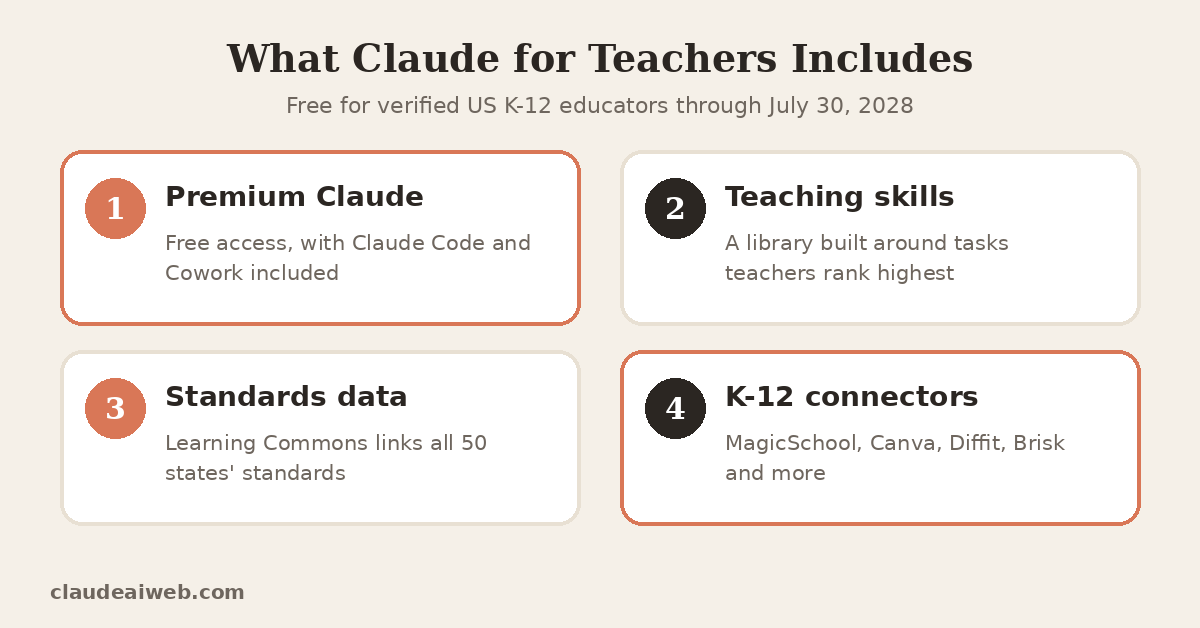
Premium Claude, Claude Code and Cowork
The teachers receive a top quality version, not a scaled down version of the demo. This package also includes Claude Code and Cowork so that Claude can pick up things without assistance. You may never have to use Claude Code. However, the significance of Cowork is more than meets the eye.
A Teaching Skills Library
The skills were developed based on activities that have the highest priority from the perspective of teachers. These skills have been designed in partnership with Learning Commons and focus on lesson planning and differentiation. The developers can examine them as well. The skills have been published open source in Anthropic.
Standards Data Across All 50 States
I was most amazed by this feature. The Learning Commons connector provides standards for every state in the United States, and the smaller competencies under each state standard. So Claude creates lessons aligned to expectations for your state. It also attracts trusted curriculum like OpenSciEd and Illustrative Mathematics.
Nine K-12 Connectors
Claude also mentions the teaching materials teachers use. These include ASSISTments, Brisk Teaching, Canva Education, Coteach, Diffit, Eedi, MagicSchool, Snorkl and TeachFX. Specifically, Diffit works with resources, and Eedi develops diagnostic questions.
| Connector | What it does for you |
| ASSISTments | Builds auto-scored math practice |
| Brisk Teaching | Creates standards-aligned lessons |
| Canva Education | Turns materials into designs |
| Diffit | Adapts texts for every learner |
| Eedi | Writes diagnostic questions |
| TeachFX | Gives feedback on classroom talk |
The Connector Beats the Price Tag (My Opinion)
Everyone talks about “free.” I think that misses the point. Plenty of tools cost nothing. Few know your state’s standards.
Generic AI writes generic lesson plans. A plan tied to real standards saves editing time. Consequently, the Learning Commons link matters more than the zero-dollar price.
How Teachers Can Use Claude Day to Day
Let’s move from features to routines. Anthropic highlights two core jobs.
Planning a lesson. Ask for a lesson, and Claude drafts a plan and student-facing materials you can revise. You still steer the result. Edit it until it sounds like your classroom.
Differentiating for every learner. Claude adapts materials to different readiness levels and builds a differentiation plan. This task usually eats evenings. Therefore, it offers the biggest time saving.
Beyond those, here are routines I’d try:
| Task | How Claude helps | Your role |
| Rubrics | Drafts criteria and levels | Adjust to your standards |
| Parent emails | Drafts a warm first version | Add real details, then send |
| Exit-ticket review | Spots class-level patterns | Decide the next lesson |
| Reading levels | Rewrites texts at two levels | Check accuracy |
| Quiz banks | Writes varied questions | Verify every answer key |
Scheduled work stands out too. You can hand off a task once, such as reviewing de-identified exit tickets each school day at 4pm. The result waits for you by evening.
For coding or automation questions, see our comparison of Claude Code vs Claude Chat.
Specific Input Wins (My Real-Use Observation)
I do not teach in the classroom. When I test Claude, I test everything. In the same way, I test him with actual planning tasks and tight editing. One pattern was quickly identified.
Vague instructions lead to vague plans. “Lesson on fractions” resulted in textbook filler for me. Detailed instructions made a huge difference. I gave the grade level, time, standard, and short class description. The plan became practical.
Teachers can replicate that behavior. Spend two minutes crafting your instructions. Save twenty minutes of editing. Context always beats clever wording.
Keep Feedback Human (My Opinion)
Claude can compose feedback remarks. Do you just copy and paste them into your assignments? I suggest not to.
Students see when you give them generic feedback. They also see when you have truly read their assignments. Let Claude collect common patterns within a whole class. Write personal remarks yourself.
This division helps keep the interpersonal connection, which is key to learning. The marketing of Anthropic itself confirms that. The company aims to help teachers use this tool to spend more time building interpersonal connections.
Student Privacy
Privacy determines your ability to use this tool safely. Anthropic has created a number of safeguards. Training is not available to verified teacher accounts, and K-12 Data Processing Addendum safeguards student information through FERPA-compliant controls.
But the presence of safeguards doesn’t mean consent. It is the policies of your district and state that determine the use of your education data. In August 2026, Anthropic also changed their earlier examples. The new post now uses de-identified classroom data and states that identifiable student information requires school or district authorization.
I follow my own traffic-light rule.
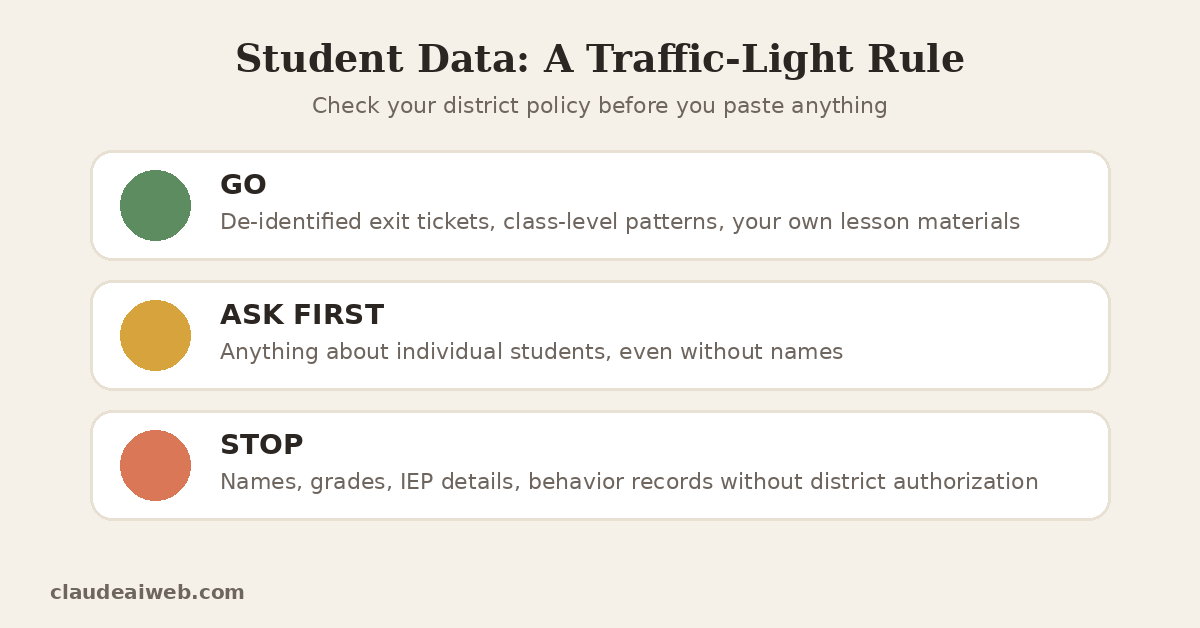
- Go: de-identified exit tickets, class-level patterns, and your own materials.
- Ask first: anything about individual students, even without names.
- Stop: names, grades, IEP details, or behavior records without authorization.
Policy changes also help. On November 10, the AFT and its New York affiliate signed a legally binding agreement with Anthropic on safety and privacy. The standard automatically applies to Anthropic’s agreements with school districts using Claude for Teachers. That adds enforceable protection beyond promises.
Want to clear your own history? Read our guide on how to delete Claude chat history.
Who Qualifies, and How Verification Works
Eligibility remains limited. Anthropic provides the training to educators who teach at US K-12 institutions. Verification will be necessary. Reports indicate that verification demands proof of US K-12 employment. Anthropic has not provided an exact process for verification yet.
Teachers outside the US face a gap. College instructors face one too. You still have options.
| Your situation | Best option |
| US K-12 teacher | Claude for Teachers (free) |
| Teacher outside the US | Free plan, or Pro at 20monthly(17 annual) |
| University staff | Ask about Claude for Education at your school |
| School or district leader | Explore the district offering |
University staff should read our guide on Claude for Students, which covers campus access. Teachers outside the US should confirm current prices on Anthropic’s pricing page.
Where the Program Falls Short
I like the program. However, five weaknesses must be noted.
- It’s US-only. There is no possibility for International teachers to join. A lot of people work on limited resources and would benefit from the most. This is the largest equity divide.
- The offer is for persons. It is not possible for one teacher to change the workflow of a department. Districts are responsible for making their own arrangements.
- Early there was confusion about privacy. After launch, Anthropic updated their original examples. The fix shows responsiveness. It also demonstrates that it is easy to incorrectly interpret data rules.
- There is limited evidence of student progress. The research is in its infancy, admits Anthropic. Preliminary findings indicate that AI tools for students have yielded mixed results and that AI tools for teachers can support student practice. Beware of big promises.
- Free access is a limited time offer. July 2028 seems like a long way away. While this may seem like a good idea, it is important to have a plan for what will happen next if you build a habit now.
None of these are negative aspects of the program. It just means you don’t let your mind turn off.
Free Training for Teachers
Anthropic has developed a course as well. Teachers may join AI Fluency for PK-12 Teachers that Anthropic developed in collaboration with Teach For America. This course is agnostic to models and practical. This course will talk about what types of classroom tasks are appropriate for using AI.
I would do this course before you introduce any AI stuff to students. It is very brief, but effective. Teacher who knows about AI limitations would make better decisions.
A Simple Starter Plan for Your First Week
New to Claude for Teachers? Try this schedule.
| Day | Task | Goal |
| Monday | Complete verification | Unlock the program |
| Tuesday | Plan one lesson | Test standards alignment |
| Wednesday | Differentiate that lesson | Compare reading levels |
| Thursday | Draft one rubric | Check clarity |
| Friday | Read your district’s AI policy | Set data rules |
Stay realistic about outcomes. You won’t transform your classroom in a week. However, you’ll learn quickly whether the tool fits your routine.
If Claude slows down on a busy morning, check our Claude status page. Meanwhile, our AI News section tracks program changes.
Final Verdict
Claude for Teachers has much to offer teachers in the US. It provides free and standard-compliant planning support with union-approved privacy protection agreements. The extension until July 2028 makes it simpler to sign up.
Use it to plan, differentiate instruction, and draft assignments regularly. Maintain control over feedback, judgments, and student data. Most importantly, adhere to the policies set by your district.
If you are a teacher in another country, Claude for Teachers helps understand what the future holds for education-related AI applications.
Frequently Asked Questions
Is Claude for Teachers really free?
Who can join Claude for Teachers?
Can teachers outside the US use it?
Not currently. Teachers elsewhere can use the free plan or pay for Pro. Check Anthropic’s site for expansion news.
Does Claude train on my teacher conversations?
Can I upload student names and grades?
Is there an option for schools and districts?
Does the program include Claude Code?
Yes. Claude for Teachers includes Claude Code and Cowork. Most teachers will use Cowork for scheduled and multi-step tasks.