Who Owns Claude.ai? Deep Look at Power Behind the Screen
When I’m deep in a research session with Claude, I often forget I’m talking to a product owned by a multi-billion-dollar startup. But as a power user, I’ve realized that who owns the AI is just as important as how the AI performs. It’s all about ownership. This will determine whether the artificial intelligence tries to sell you something, keep your data safe, or just give you the best answer.
Curious to know how things work at Claude.ai? Here’s what you need to know from an on-the-ground perspective.
Who Actually Owns Claude.ai?
Let’s start with the clear answer:
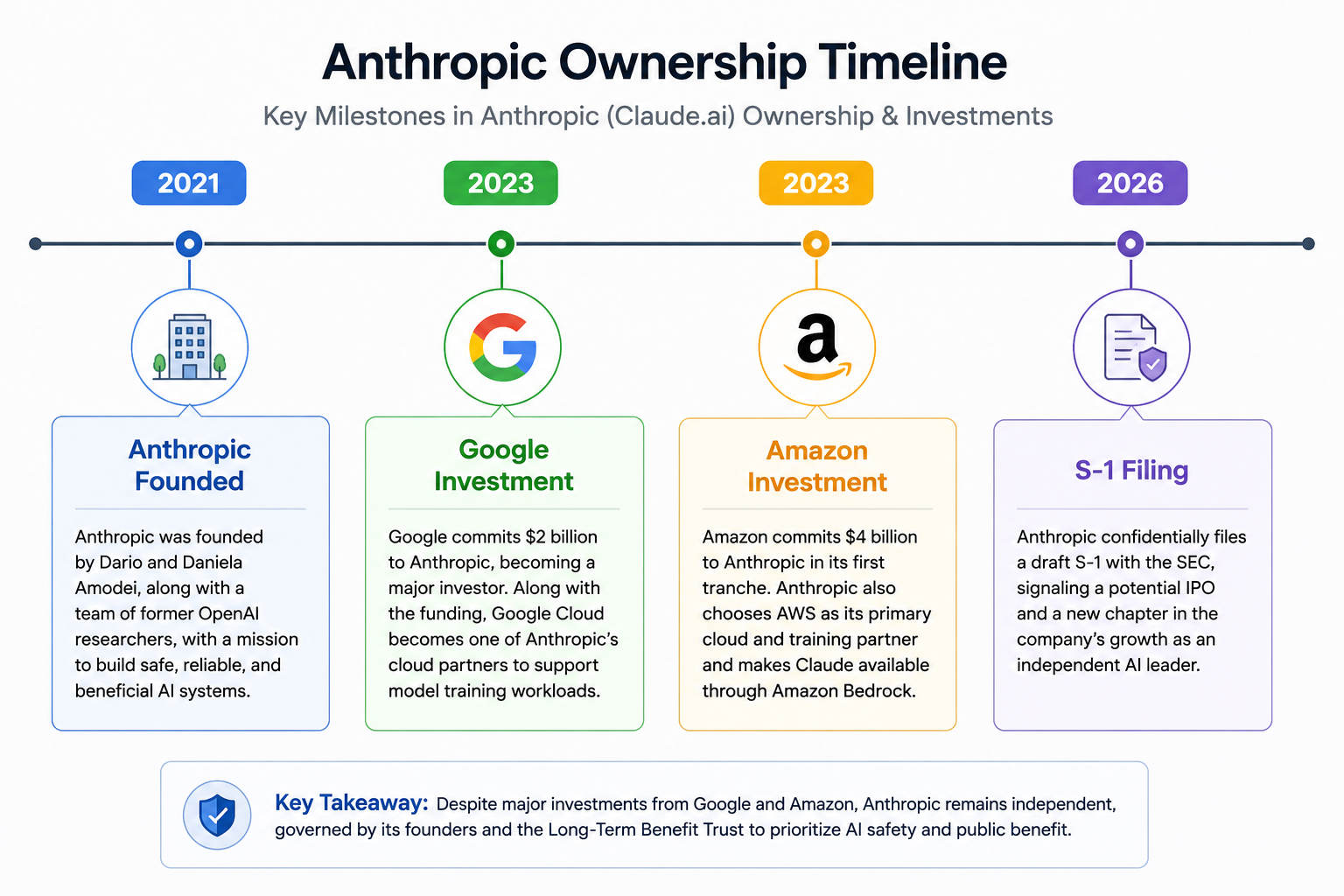
Claude.ai belongs to Anthropic. It was incorporated in 2021 with two siblings, Dario and Daniela Amodei, heading the company. They were both employees of OpenAI. Anthropic was formed in order to create an AI with clear values, safety, and actions.
Unlike other companies developing AI, Anthropic is dedicated to the responsible development of AI.
This approach shapes every tool they build, including Claude. Here is a quick snapshot of the company:
Key Facts About Anthropic
| Detail | Information |
| Founded | 2021 |
| Founders | Dario & Daniela Amodei |
| Headquarters | San Francisco, California |
| Focus | Safer, reliable, value-driven AI |
Anthropic believes that AI should help people, not overwhelm them. This philosophy drives Claude’s development, shaping its tone, accuracy, and reliability.
A Timeline of Key Milestones
| Year | Event |
| 2021 | Anthropic was founded by former OpenAI researchers |
| 2022 | Claude launched; FTX Ventures invests ~$500M. |
| 2023 | Amazon commits $4B (first tranche); Google commits $2B |
| 2024 | Amazon completes second $4B tranche; FTC opens inquiry into AI partnerships |
| Early 2025 | Anthropic valuation reaches $61.5B in Series G; annualized revenue approaching $2B |
| Late 2025 | Microsoft and Nvidia commit $5B and $10B, respectively |
| Early 2026 | Amazon’s stake reportedly worth $70B+; Google’s 14% stake worth ~$135B |
| June 2026 | Anthropic confidentially files draft S-1 with the SEC, signaling a potential IPO |
Why I Personally Looked Into Claude’s Ownership
When I first started using Claude seriously, I noticed something different.
Claude was:
- More cautious with assumptions
- Better at handling long documents
- Less likely to hallucinate facts
- More consistent in tone
That made me curious. These behaviors don’t happen by accident. They usually reflect company-level decisions, not just model architecture. That curiosity pushed me to investigate who owns Claude, who funds it, and how independent it really is.
The “Big Tech” Confusion (Do Google or Amazon Own Claude?)
This is the most common point of confusion. The answer is no, with important nuances.
Amazon’s Role
Since 2023, Amazon has committed about $8 billion to Anthropic in various rounds, while there is speculation that further commitments could amount to $25 billion or even more. In return, Anthropic appointed AWS as its preferred cloud and training partner for its large language model called Claude.
Amazon holds no board seats, no voting rights, and no control over Anthropic’s research direction or product decisions. The investment is better understood as a deep infrastructure deal with equity upside — Amazon benefits when Anthropic scales, because Anthropic runs on Amazon’s servers.
Google’s Role
Google holds approximately 14% equity in Anthropic, a figure confirmed through court documents filed in a US antitrust case. That stake is contractually capped at 15%. Like Amazon, Google holds no voting rights, no board seats, and no board observer rights.
Google’s investment came with a similar cloud partnership: Anthropic uses Google Cloud for some of its training workloads.
Ownership Structure at a Glance
| Anthropic (Delaware PBC) │ ├── Founders (Dario & Daniela Amodei + co-founders) │ └── Retain meaningful equity + operational control │ ├── Long-Term Benefit Trust (LTBT) │ └── Holds special Class T shares; can elect/remove board members │ └── Acts as a mission guardian independent of shareholders │ ├── Amazon (~largest minority stake; no board/voting rights) ├── Google (~14% equity, capped at 15%; no board/voting rights) ├── Microsoft, Nvidia, and others (committed in 2025) └── Venture firms (Menlo Ventures, Spark Capital, Sequoia, etc.) |
The Corporate Structure That Actually Matters
Most coverage focuses on the dollar figures and misses the governance layer that makes Anthropic unusual.
Public Benefit Corporation
Anthropic is incorporated as a Delaware Public Benefit Corporation (PBC), which legally requires its directors to weigh public benefit. In this case, AI safety alongside shareholder returns. This is not just a marketing position; it has legal standing.
The Long-Term Benefit Trust
More significantly, Anthropic created a Long-Term Benefit Trust (LTBT) that holds a special class of shares, giving it the power to elect or remove board members. The trustees are independent of investors and are focused on AI safety and public benefit. No investor — including Amazon or Google — can override the trust.
This is a novel structure with no clear precedent in Silicon Valley. It functionally means that even if investors eventually push for mission drift, the LTBT provides a structural check.
What the Money Actually Buys
Amazon and Google are not writing these checks out of charity. Their investments serve clear strategic interests:
- Infrastructure lock-in: Anthropic’s cloud commitments generate substantial AWS and Google Cloud revenue.
- Competitive hedging: Both companies compete in AI. Backing Anthropic gives them exposure to a leading model company without acquiring it, which would trigger antitrust review.
- Equity upside: Amazon’s $8B investment was reportedly worth over $70B as of early 2026. Google’s 14% stake was worth approximately $135B at Anthropic’s $965B valuation.
The FTC and the UK’s Competition and Markets Authority have both examined these partnerships for signs of de facto control. Neither blocked the investments, but both signaled ongoing monitoring.
What This Means for Users
Accountability
Because Anthropic retains full control, its safety guidelines and product decisions are not subject to override by investors with different incentives.
Stability vs. Risk
The LTBT structure protects the mission in the short term. However, as Anthropic approaches a potential IPO (it confidentially filed a draft S-1 with the SEC in June 2026), the governance structure could face pressure. Public markets typically prefer simpler, more shareholder-friendly arrangements.
Comparing Ownership Across AI Assistants
| AI Tool | Developer | Key Investors | Control |
| Claude | Anthropic | Amazon, Google, Sequoia, others | Founders + LTBT |
| ChatGPT | OpenAI | Microsoft (~49% non-voting) | Board (restructuring ongoing) |
| Gemini | Google DeepMind | Alphabet (owner) | Alphabet |
| Grok | xAI | Elon Musk + private investors | Elon Musk |
A Personal Note on Claude’s Behavior
I’ve spent hundreds of hours using Claude, and it does behave differently from ChatGPT or Gemini in ways I’d characterize as more deliberate and conservative. In my experience, Claude tends to hedge more on ambiguous claims, acknowledge uncertainty more explicitly, and push back more on tasks it finds ethically fuzzy.
Whether that reflects the ownership structure, the training methodology, or some combination, I genuinely can’t say with certainty. These are personal observations, not controlled benchmarks. But it’s consistent with a company whose stated mission centers on reducing AI risk.
The Bottom Line
Anthropic owns Claude. Amazon and Google have significant financial stakes and infrastructure deals, but neither controls the company’s direction. A novel governance structure — the Long-Term Benefit Trust — adds an extra layer of mission protection beyond what most AI startups have.
That structure is about to face its first major test as Anthropic moves toward a potential public offering. Whether the “safety-first” mission survives contact with public markets is the most important ownership question Claude users should be watching.
For more on Claude’s capabilities and how it compares to other models, the Anthropic research page is the most authoritative source.
If you want to learn more about Claude’s capabilities, check out our guides on ClaudeAIWeb, such as the Claude 3.5 Sonnet overview or the Claude vs ChatGPT comparisons. These resources help readers explore Claude from many angles.
Why You Should Care
Ownership isn’t just a corporate fact; it’s a feature. The reason Claude is excellent at long-document analysis and “Constitutional” reasoning is that its owners prioritized those traits over raw speed.
As we move into 2026, keep an eye on these partnerships. If a major tech giant eventually acquires Anthropic fully, the “Claude” we love today might change. For now, its independence is its greatest strength.
If you want more guides about Claude, visit ClaudeAIWeb for tutorials, comparisons, feature explainers, and model updates.
FAQs
1. Who owns Claude.ai?
Anthropic owns Claude.ai, controls its development, and oversees every Claude model. The company builds Claude with a strong focus on safety, reliability, and transparent AI behavior. No external investor holds ownership or decision-making power over Claude’s core technology or mission.
2. Does Amazon own Claude AI?
No. Amazon does not own Claude AI. It invested billions to support Anthropic’s cloud and research expansion, but Amazon has no control over Claude’s development or direction. Anthropic keeps full ownership and independence despite receiving large-scale financial backing.
3. Does Google own Claude AI?
No. Google does not own Claude AI. It provided significant funding to support Anthropic’s growth, but the investment does not grant ownership rights or authority. Anthropic maintains total independence while using Google’s support to improve infrastructure and expand Claude’s capabilities.
4. Did OpenAI create Claude?
No. OpenAI did not create Claude. Former OpenAI researchers founded Anthropic after leaving the company. They built Claude independently with a new vision focused on safer, more transparent AI models, separate from OpenAI’s research direction and development structure.
5. Can I invest in Claude AI?
Currently, you cannot invest in Claude AI because Anthropic remains a private company. Public investment options may emerge if Anthropic decides to go public or open shares in the future, but no public offering exists right now.